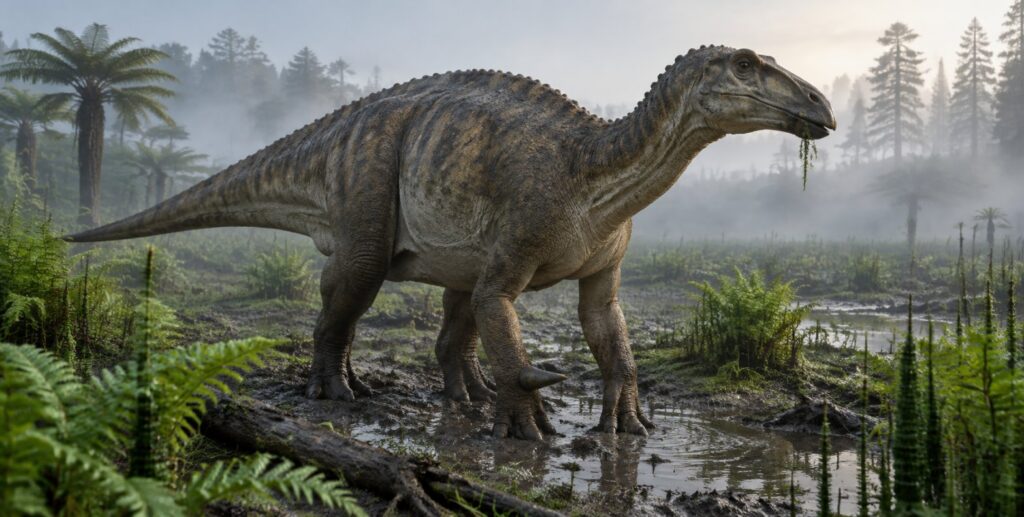
The dinosaur waited 25 years in a museum storage room! A new species from a brickyard in Surrey has been named in honor of its manager
Sometimes a great discovery takes a quarter of a century to be made. The dinosaur bones excavated in 2001 in a brick kiln in the Ewhurst in Surrey County they lay dormant in collections Natural History Museum 25 years in London. Only now have scientists announced that this is an entirely new genre – and this is a new kind right away.
The Jurassic dinosaur from Surrey
The animal was given a name Paludohadros proudlovii. The first part comes from the Latin word meaning swamp – about 125 million years ago, in the early Cretaceous, the south of England was covered with muddy swamps. This is a relative of the famous iguana: a large herbivore that walks on four legs, with a characteristic claw on its thumb. It was about 5 meters long and weighed 1.5–2 tons, or roughly the same as a rhinoceros. The bones were not fully developed, so it was most likely a young individual – an adult could be even twice as large.
Name in memory of the brickyard manager
The second part of the name commemorates Willa Proudlove’s villa, The brickyard manager, who went from being an ordinary worker to a boss there. He was always curious about what lay hidden in the layers of clay below. He died at the age of just 35 – a year before the dinosaur was found in the mine. His wife Rachael said that the family is „blessed and honored” that Will’s name will live on in the name of the dinosaur.
The neighbor of a dangerous predator
The new species was found just 100 meters from the place where the famous one was discovered in 1983. Baryonyxa – a carnivorous dinosaur that ate fish, but remains of a young iguana were also found in its stomach. Scientists admit that Baryonyx he could hunt young animals Paludohadrosy or eat their dung.
And that’s not all: further specimens of this species have already been identified in the museum’s collections, collected back in the 1950s. The doctoral student who described the dinosaur will now examine the entire collection – so there could be more undiscovered species waiting in the archives of the London museum. A good excuse to take the children to the Natural History Museum for a winter weekend – admission to the permanent exhibitions is free.
Source: SWNS, 11.11.2026 (study in the „Journal of Systematic Palaeontology”). Text: Fucha.co.uk editorial team.
 Polish
 English

 , a następnie